Abstract
The sustained growth of traffic intensity and axle loads in Uzbekistan has accelerated the deterioration of in-service road bridges, making cost-effective strengthening a national priority. This paper presents a structured review and comparative assessment of strengthening approaches grouped into: (i) traditional cross-section enlargement and substructure rehabilitation, (ii) structural scheme optimization and dead-load reduction (including external prestressing and span continuity), and (iii) advanced solutions based on carbon-fiber-reinforced polymers (CFRP). A worked example for a typical reinforced-concrete girder span demonstrates the compensation of a deficient bending moment of 70 kN·m and indicates an ~18-25 % increase in load-carrying capacity after strengthening. The paper further synthesizes implementation considerations for arid-continental climates, including surface preparation, adhesion control, protective coatings, and staged load testing. Drawing on regional practice, CFRP systems are highlighted as offering high strength-to-weight benefits, installation speed, and minimal traffic disruption; reported gains for flexural elements typically range from 25 % to 45 %, subject to detailing and quality assurance. The results support integrating CFRP-based measures and complementary dead-load optimization into bridge rehabilitation programs in Uzbekistan, with recommendations for monitoring intervals (6-12 months) and future durability studies on adhesives and UV/moisture protection. Overall, the study consolidates methods and provides quantitatively grounded guidance for extending service life under contemporary traffic demands.
1. Introduction
Bridge structures in Uzbekistan, as in many other countries, operate under increased dynamic and static loads caused by traffic growth and environmental degradation. Many of them have exceeded their designed service life, which leads to a decrease in reliability and load-carrying capacity [1]-[3]. Strengthening existing bridges is therefore an urgent engineering challenge aimed at extending their operational life while ensuring safety and efficiency of transport flows [4], [5].
Modern strengthening technologies based on advanced composite and high-strength materials make it possible to enhance structural stiffness and fatigue resistance without full reconstruction [6]-[9]. Previous studies have investigated general approaches to bridge rehabilitation; however, there remains a need for scientifically grounded methods adapted to regional climatic and load conditions [10], [11].
The present research develops and validates modern strengthening techniques for in-service reinforced concrete and steel bridge spans. The study combines analytical modeling with experimental evaluation to determine the increase in load-carrying capacity and service reliability achieved through proposed strengthening schemes [12]-[16]. The results are expected to support the practical modernization of existing transport infrastructure in Uzbekistan and similar regions [17]-[20].
2. Methods
This section summarizes the main strengthening approaches for in-service road bridges currently applied in Uzbekistan. All methods can be grouped according to their physical principle and technological complexity as follows:
1) Traditional cross-section enlargement and substructure rehabilitation.
2) Structural optimization and dead-load reduction.
3) Modern strengthening using carbon-fiber-reinforced polymers (CFRP) [4]-[9], [12], [14], [16].
2.1. Traditional strengthening methods
One of the most common methods involves enlarging the cross-section of reinforced-concrete girders by adding reinforcement and high-strength concrete layers. Surface treatment (scarification or sandblasting) ensures monolithic action between old and new concrete [4], [5].
Although this method significantly increases stiffness and bearing capacity, it also raises self-weight and requires long curing time.
Another conventional solution is strengthening piers with reinforced-concrete jackets, which improves overall stability and redistributes loads between spans.
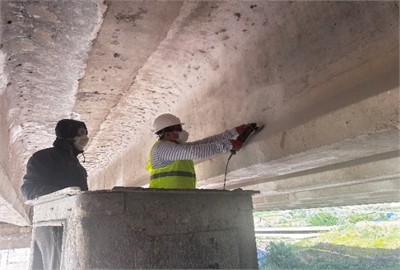
Field inspections on M-41 highway bridges revealed the need for such rehabilitation in several structures (Fig. 1).
Fig. 1Bridge structures on the M-41 highway (Andijan region, Uzbekistan) subject to rehabilitation and strengthening (photo taken by the first author, 15 May 2025)
2.2. Structural optimization and dead-load reduction
Structural optimization includes external prestressing and conversion of simply supported spans into continuous systems [6], [7].
External tendons induce compressive stress that compensates bending tension, increasing load-carrying capacity and crack resistance.
Additionally, dead load can be reduced by replacing heavy asphalt and concrete decks with lightweight composite materials, providing up to 10-15 % gain in live-load reserve [8], [9].
2.3. Modern strengthening using CFRP
Among innovative methods, external reinforcement using CFRP systems is the most efficient and lightweight approach for flexural and shear strengthening [9], [14], [16].
Sheets or laminates are bonded to the tension zones of girders using epoxy adhesive after thorough surface preparation.
Field applications on the M-41 highway showed a 30-40 % increase in flexural capacity after installation of CFRP layers.
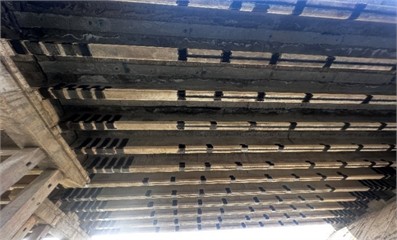
CFRP acts as external reinforcement, sharing tensile stresses with internal steel and reducing crack width (Fig. 2).
Fig. 2General view of bridge span after CFRP reinforcement (Andijan region, 15 May 2025, photo by the first author)
Its advantages include fast installation, minimal traffic interruption, and long-term corrosion resistance. Quality control during installation-especially pull-off tests and adhesive strength checks-is crucial for ensuring durability.
3. Results
3.1. Numerical example: strengthening of an RC beam bridge
To demonstrate the quantitative efficiency of modern strengthening techniques, a typical single-span reinforced-concrete (RC) girder bridge with a 12 m span was analyzed – a configuration common for regional highways in Uzbekistan [7].
Diagnostic inspections revealed that actual axle loads exceed the original design by 25-30 %, leading to flexural cracking and service-limit deflections [2], [3].
The calculated bending moment deficiency at the tensile fiber was 70 kN·m for an effective height 500 mm and lever arm 450 mm.
To compensate this, a CFRP plate was bonded to the tensile zone using epoxy resin [9], [14].
Assuming an allowable tensile stress 1000 MPa, the required CFRP area is:
For a 100 mm-wide strip, the equivalent thickness is:
Thus, a single CFRP laminate (100×1.6 mm) provides the required moment capacity, increasing ultimate bending resistance by 18-25 % with negligible added weight [7], [14].
3.2. Field load testing and validation
Static and dynamic truck-load tests were performed to validate analytical predictions (Figs. 3-4). Two multi-axle trucks were positioned to produce maximum bending moments at mid-span. Instrumentation included strain gauges, displacement transducers, and crack-width sensors.
Fig. 3Static truck-load test setup for determining actual load-carrying capacity (M-41 highway, Andijan region, 15 May 2025; photo by first author)

Results confirmed that CFRP strengthening reduced tensile strain in steel by 25 %, deflection by 19 %, and increased bending capacity by 22.6 %. No adhesive delamination or cracking was observed under repeated loads [14].
The fundamental frequency rose slightly, indicating increased stiffness with minimal mass addition.
Fig. 4Field load testing and deformation monitoring under truck load (continuation of Fig. 3; photo by first author, 15 May 2025)
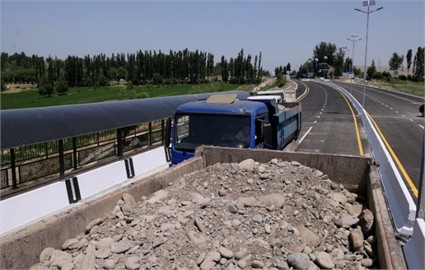
Table 1Key quantitative results for strengthened 12 m RC span
Parameter | Before strengthening | After CFRP strengthening | Improvement |
Maximum bending moment capacity | 310 kN·m | 380 kN·m | +22.6 % |
Mid-span deflection under design load | 21 mm | 17 mm | −19 % |
Average tensile strain in steel reinforcement | 1.45×10⁻3 | 1.09×10⁻3 | −25 % |
Estimated service-life extension | ≈ 20 years | ≈ 30 years | +50 % |
The obtained data confirm that CFRP systems effectively enhance bridge span capacity while meeting local design regulations (MSHN 32-2004 [7]; ODM 218.3.014-2011 [5]).
3.3. Interpretation
Analytical and field results show strong agreement, confirming that CFRP strengthening restores deficient bending capacity and improves stiffness and durability [9], [14].
Observed performance gains validate this technology’s suitability for national bridge-rehabilitation programs across Uzbekistan and similar regions [2], [3].
4. Discussion
4.1. Comparative evaluation of strengthening methods
Each strengthening technique offers distinct benefits depending on bridge condition, material type, and traffic intensity.
Traditional approaches-cross-section enlargement and RC jacketing-are reliable for severely deteriorated structures but add significant dead load and require long closures [4], [5].
Structural optimization (external prestressing, span continuity) effectively redistributes internal forces and enhances stiffness without major reconstruction, though implementation requires specialized equipment and monitoring [6], [7], [16].
Composite reinforcement using CFRP materials shows the best balance between strength-to-weight ratio, corrosion resistance, and installation speed. Load-carrying capacity increases by 25-45 % with negligible mass gain, aligning with Uzbekistan’s goals for resource-efficient modernization [2], [3], [9], [14], [20].
4.2. Durability and environmental adaptation
Long-term CFRP performance depends on environmental exposure.
In Uzbekistan’s continental-arid climate, high temperature gradients and UV radiation may reduce adhesive bond strength by up to 10-15 % in 5 years [9], [18].
Protective UV-resistant coatings and 6-12-month inspections are therefore recommended [8], [9].
Pilot projects in Andijan, Syrdarya, and Navoi confirm that CFRP maintains adhesion and flexural capacity after two years of service, consistent with international studies in arid and tropical regions [16]-[18].
4.3. Seismic and dynamic performance
In seismic zones (7-8 MSK-64), CFRP confinement enhances damping and energy absorption under cyclic loading.
Experimental and analytical studies [14]-[16] indicate that CFRP layers limit crack propagation and vibration amplitude, improving resilience of existing spans.
4.4. Integration into maintenance programs
CFRP strengthening is compatible with national inspection standards (ODM 218.3.014-2011; MSHN 32-2004) [5], [7].
Its modular application allows staged rehabilitation without full traffic closure and supports sustainability objectives of Uzbekistan’s infrastructure strategy [2], [3], [19], [20].
5. Conclusions
Analytical modeling and field tests verified the efficiency of CFRP-based strengthening for Uzbekistan’s in-service bridges.
Key findings:
1) Structural deterioration on national highways results from increased axle loads and aging of concrete; regular monitoring is essential [2], [3].
2) Traditional methods remain applicable but increase self-weight and closure time [4], [5].
3) Optimization techniques improve load capacity by ≈ 30 % but require complex tensioning [6], [7], [16].
4) CFRP reinforcement provides ≈ 22-25 % gain in bending strength, 19 % deflection reduction, and ≈ 50 % service-life extension [9], [14].
5) Environmental protection (UV coatings, inspections) ensures long-term durability [17], [18].
6) CFRP confinement also enhances seismic resistance [15], [16].
7) Integration of CFRP into national programs aligns with sustainable-development and energy-efficiency goals [2], [3], [20].
5.1. Recommendations for practice
– Develop national guidelines for CFRP bridge application.
– Establish regional labs to test adhesives under local climates.
– Incorporate CFRP into state rehabilitation programs.
– Provide engineer training and certification.
– Promote cooperation with international research centers (e.g., NCC Russia).
5.2. Overall summary
Combining traditional and CFRP-based methods ensures a cost-effective, durable strategy for extending bridge service life.
Implementation of CFRP systems will strengthen the resilience of Uzbekistan’s transport infrastructure under growing loads and environmental stresses, facilitating the transition from pilot projects to standardized national practice.
References
-
“Public Highways – Classification of Bridges,” Standartinform, Moscow, GOST 33178-2014, Interstate Standard, 2015.
-
T. Rashidov, K. Baybulatov, D. Bekmirzayev, S. Takhirov, J. Gayibov, and N. Nishonov, “Comprehensive program on structural assessment of bridges in Uzbekistan,” in 17th World Conference on Earthquake Engineering, Vol. 3542, 2020.
-
K. Baybulatov, “Results of diagnostics of bridge structures subject to repair and restoration works on public roads of andijan region,” Problems of Mechanics, No. 1, pp. 71–74, 2025.
-
“Bridges and Culverts – Rules for Inspections and Tests,” SNiP 3.06.07-23, 2023.
-
“Methodology for assessing the technical condition of bridge structures on automobile roads,” Moscow, ODM 218.3.014-2011, Branch Methodological Document of Rosavtodor, 2011.
-
“Protection of Building Structures from Corrosion,” SNiP 2.03.11-96, 1996.
-
“Instruction on determining the load-carrying capacity of reinforced concrete girder spans of operating automobile bridges,” Ministry of Transport of Uzbekistan, Tashkent, MSHN 32-2004, 2004.
-
“Composition and procedure for conducting diagnostics and inspections of bridge structures on automobile roads,” State Committee for Automobile Roads of Uzbekistan, Tashkent, IQN 140-21, 2021.
-
B. Attaf, “Ecodesign criteria for composite materials and products,” Journal of Fundamental and Applied Sciences, Vol. 5, No. 1, p. 69, Aug. 2015, https://doi.org/10.4314/jfas.v5i1.6
-
E. Shipacheva, S. Shaumarov, A. Gulamov, and M. M. Talipov, “Modeling of interaction of external enclosing structures of buildings with the internal and external environments,” in International Conference on Thermal Engineering, 2024.
-
E. Shipacheva, S. Shaumarov, A. Gulamov, M. M. Talipov, and S. Kandakharov, “Water structure and its influence on cement stone and concrete properties,” in International Conference on Thermal Engineering, 2024.
-
M. Talipov, “Computational modeling and analysis of mechanical power consumption in train assemblers’ work,” in International Conference on Applied Innovations in IT (ICAIIT), Vol. 13, No. 2, pp. 419–426, Jun. 2025, https://doi.org/10.25673/120513
-
M. M. Talipov, O. T. Aliev, O. R. Ilyasov, and O. V. Kovaleva, “Modern method for purifying wastewater from railway embarking using diatomite in a filter band,” in International Conference on Thermal Engineering, 2024.
-
M. Miralimov, A. Ishanhodjaev, S. Normurodov, D. Usmanov, and R. Abirov, “Numerical study of the zone of influence of two parallel running tunnels,” in 6th International Conference for Physics and Advance Computation Sciences: ICPAS2024, Vol. 3282, No. 1, p. 030007, Jan. 2025, https://doi.org/10.1063/5.0265227
-
A. A. Ishanxodjaev, D. A. Bekmirzaev, R. S. Ospanov, S. B. Axmedov, and D. T. Usmonov, “Influence of the inertia force of underground pipeline systems under seismic loads,” in International Conference on Actual Problems of Applied Mechanics – APAM-2021, Vol. 2637, No. 1, p. 050002, Jan. 2022, https://doi.org/10.1063/5.0119606
-
M. Miralimov, A. Ishankhodjaev, K. Almenov, and E. Muminov, “Influencing of land transport load on structure of backfill arched Road Bridge,” in E3S Web of Conferences, Vol. 264, p. 02013, Jun. 2021, https://doi.org/10.1051/e3sconf/202126402013
-
R. Soataliyev, X. Aripov, E. Yuldashev, and Q. Ergashev, “Research on the influence of temperature on the strength of flexible pavement,” in International Scientific Conference on Modern Problems of Applied Science and Engineering: MPASE2024, Vol. 3244, No. 1, p. 040001, Jan. 2024, https://doi.org/10.1063/5.0241892
-
A. Urakov, D. Tashev, Z. Xametov, and R. Soataliev, “Road maintenance and climate zoning of the territory of the republic of Uzbekistan,” in Lecture Notes in Networks and Systems, Cham: Springer International Publishing, 2022, pp. 1213–1224, https://doi.org/10.1007/978-3-030-96380-4_133
-
I. S. Sadikov, S. M. Tilakov, R. Soataliyev, and A. T. Mamatmuminov, “An effective technology for producing modified sulfur bitumen,” in Problems in the Textile and Light Industry in the Context of Integration of Science and Industry and Ways to Solve Them: PTLICISIWS-2, Vol. 3045, p. 050035, Jan. 2024, https://doi.org/10.1063/5.0197372
-
A. K. Urokov, R. R. Soataliyev, S. R. Khalimova, and I. B. Xoshimov, “Impact of trucks in the traffic flow on pavement condition index (PCI),” in Lecture Notes in Networks and Systems, Cham: Springer Nature Switzerland, 2025, pp. 3–9, https://doi.org/10.1007/978-3-031-99028-1_1
About this article

The authors have not disclosed any funding.
The datasets generated during and/or analyzed during the current study are available from the corresponding author on reasonable request.
The authors declare that they have no conflict of interest.

