Applied Mathematics
Editor's pick
Research Article
Computational analysis of turbulent flow around a NACA0012 airfoil at low Reynolds numbers using a two-fluid model
By Zokhidjon Abdulkhaev, Nilufar Kurbonova, Dildora Kadirova, Zuxriddin Umirzakov, Parviz Khujaev, Aziza Kurbanova
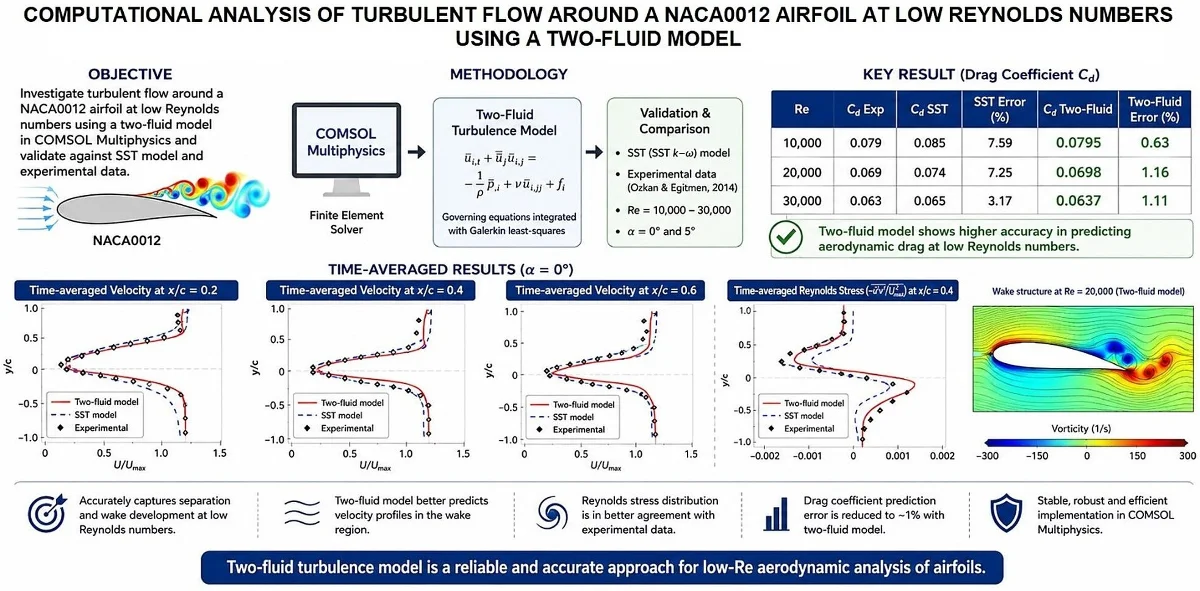
This paper presents a detailed numerical investigation of the turbulent flow structure around a NACA0012 airfoil at low Reynolds numbers using a two-fluid turbulence model implemented in the COMSOL Multiphysics environment. The study focuses on Reynolds numbers ranging from 10,000 to 30,000 at an angle of attack of α= 0°, and from 10,000 to 25,000 at α= 5°. The primary objective is to assess the capability of the two-fluid model in accurately capturing the flow separation, wake development, and turbulent stress distribution in the low-Reynolds-number regime. The obtained numerical results are systematically compared with those from the widely used Menter’s SST (Shear Stress Transport) model and available experimental data from literature to validate the accuracy and robustness of the proposed approach. The simulations demonstrate that the two-fluid turbulence model provides improved agreement with experimental measurements, particularly in predicting the velocity profiles and Reynolds stress distributions in the near-wake region. The implementation of the model within the COMSOL Multiphysics framework shows high numerical stability, reliable convergence, and computational efficiency across all tested flow regimes. Furthermore, the two-fluid model exhibits enhanced capability in describing complex anisotropic turbulence effects that are often underrepresented in traditional RANS-based models. The outcomes of this study confirm that the two-fluid turbulence model is a promising and accurate alternative for analyzing low-Reynolds-number aerodynamics, offering valuable insights for the design and optimization of small-scale air vehicles, micro air vehicles (MAVs), and other low-speed aerodynamic systems.
August 12, 2026
Informatics
Most cited
Research Article
Fault diagnosis and health management of bearings in rotating equipment based on vibration analysis – a review
By Adnan Althubaiti, Faris Elasha, Joao Amaral Teixeira
November 26, 2021
Applied Mathematics
Most cited
Research Article
A convolutional neural network method based on Adam optimizer with power-exponential learning rate for bearing fault diagnosis
By Youming Wang, Zhao Xiao, Gongqing Cao
June 30, 2022
Applied Mathematics
Most cited
Research Article
A review on wind turbines gearbox fault diagnosis methods
By H. Gu, W. Y. Liu, Q. W. Gao, Y. Zhang
January 27, 2021
Applied Mathematics
Most cited
Research Article
Bearing fault diagnosis based on improved VMD and DCNN
By Ran Wang, Lei Xu, Fengkai Liu
August 15, 2020
Applied Mathematics
Mathematical Models in Engineering
Research Article
Optimization and modelling of mahua oil biodiesel using RSM and genetic algorithm techniques
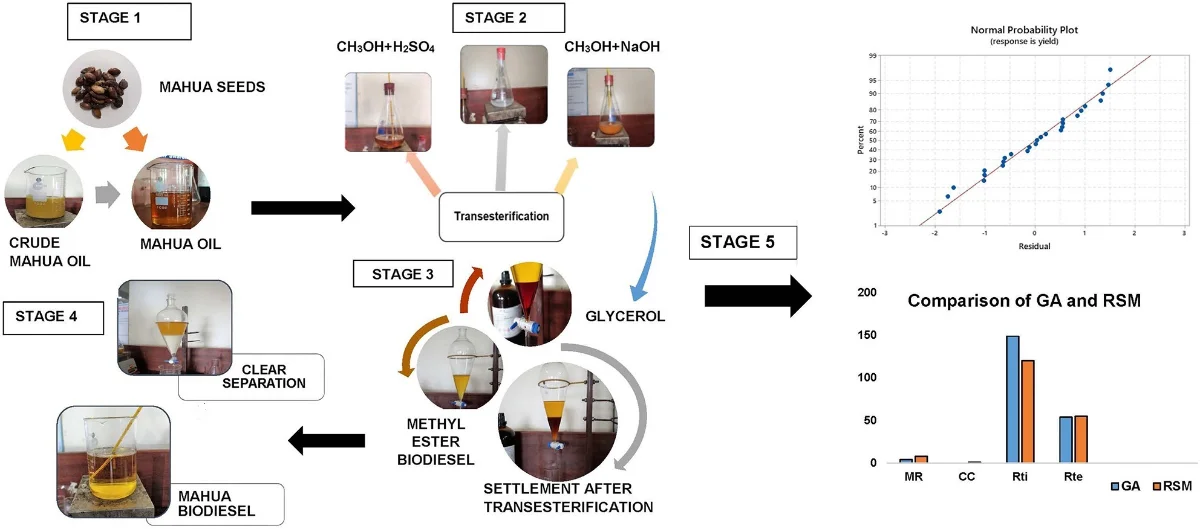
In this present investigation, four important process parameters of catalyst concentration, molar ratio, reaction time, and reaction temperature were studied and optimized using Box Behnken assisted response surface method (RSM) and Genetic Algorithm (GA) to achieve the maximum mahua oil biodiesel yield. For this purpose, 27 experiments were conducted randomly based on the design matrix using statistical software MiniTab®2019. A maximum yield of 91.32 % is achieved in RSM, catalyst concentration and reaction time are identified as influence parameters in biodiesel yield. GA modelling show an improvement of 4.96 % in biodiesel yield compared to RSM approach. Both techniques are successfully tested in prediction and modelling the biodiesel yield from mahua oil. The obtained biodiesel from the transesterification process is blended with standard diesel fuel at various proportions (B10 to B90) and tested for different fuel properties. All the biodiesel blends are observed within the limits of international standards of ASTMD-6751 and EN-14214. The results indicate that the chosen models are highly accurate in achieving maximum biodiesel yield and mahua biodiesel is recommended as the best alternative fuel to diesel engines without any major modifications in the engine design.
June 2, 2020
Informatics
Research Article
Optimization of palm methyl ester and its effect on fatty acid compositions and cetane number
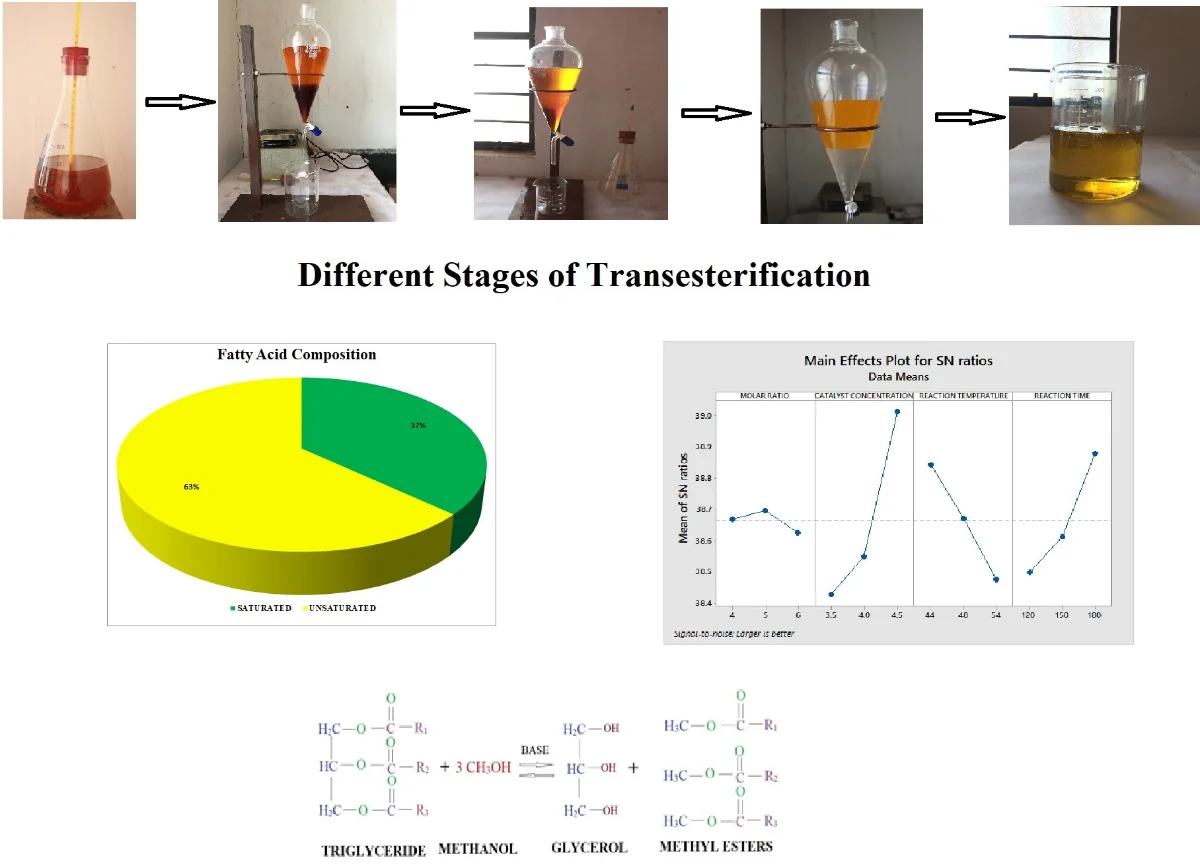
This paper proposes the Taguchi based optimization technique for the production of biodiesel from palm oil. For this purpose, L9 orthogonal array was successfully used for better yield estimation by using Minitab-18 software. Different process variables like molar ratio, catalyst concentration, reaction time and reaction temperature were studied. A predicted yield of 92.06 % was achieved by regression analysis by maintaining the process variables of molar ratio 5:1 (methanol to oil), 4 grams of catalyst concentration (NaOH), 180 minutes of reaction time and 44°C of reaction temperature. Experimentations were conducted on the same process variables and achieved a yield of 91.65 %. By this it is clear that both experimentation and regression analysis by Taguchi are in good agreement with an error of 0.41 % which may be acclaimed as experimental error. The fatty acid compositions (FAC) were also analyzed and it is found that 37.12 % saturated and 62.88 % unsaturated fatty acids present in the palm methyl ester (PME). By using the FAC of PME the Cetane number was predicted as 55.38. The predicted Cetane number from FAC tally with experimental Cetane number. The PME is characterized for different fuel properties by following the international standards. And it is concluded that catalyst concentration and reaction temperature are the important parameters which influence PME yield, Taguchi based optimization technique will helps in predicting the maximum yield with minimum number of experiments.
March 31, 2019
Informatics
Research Article
Application of A* algorithm in intelligent vehicle path planning
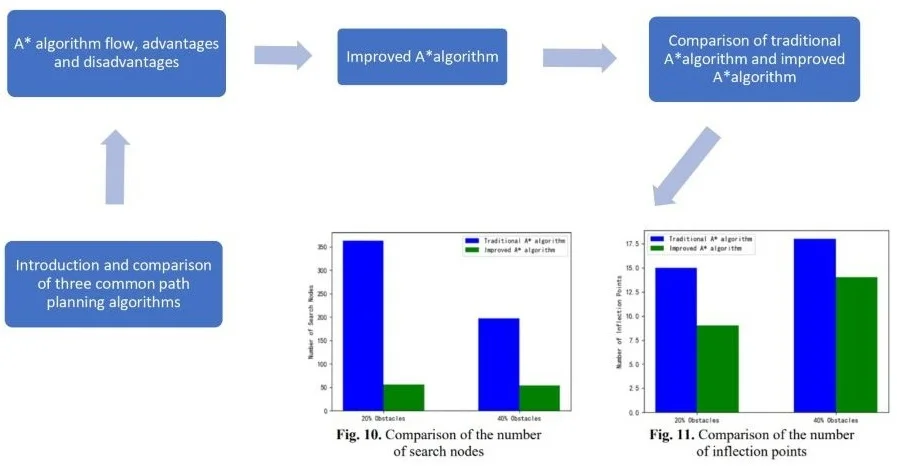
Path planning is one of the important directions in the field of intelligent vehicles research. Traditional path planning algorithms generally use Dijkstra algorithm, Breadth-First-Search (BFS) algorithm and A* algorithm. Dijkstra algorithm is a search-based algorithm, which can search to an optimal path, but the disadvantage is too many expansion nodes, which leads to insufficient search efficiency. BFS algorithm is a heuristic search algorithm, which reduces the disadvantage of too many expansion nodes and improves the search efficiency by heuristic function. A* algorithm is a heuristic search algorithm that combines Dijkstra’s algorithm and BFS algorithm, which has higher search efficiency and can search to an optimal path at the same time, but it is still lacking in the search mode and smoothness of the planned route. This paper first introduces the general path planning algorithm, then introduces and analyzes the A* algorithm, and proposes improvement measures for its shortcomings; finally, the executability and effectiveness of the improved algorithm are tested using simulation, and compared with the traditional A* algorithm, and the results show that the improved A* algorithm has good effect on path planning of intelligent vehicles.
August 17, 2022
Informatics
Research Article
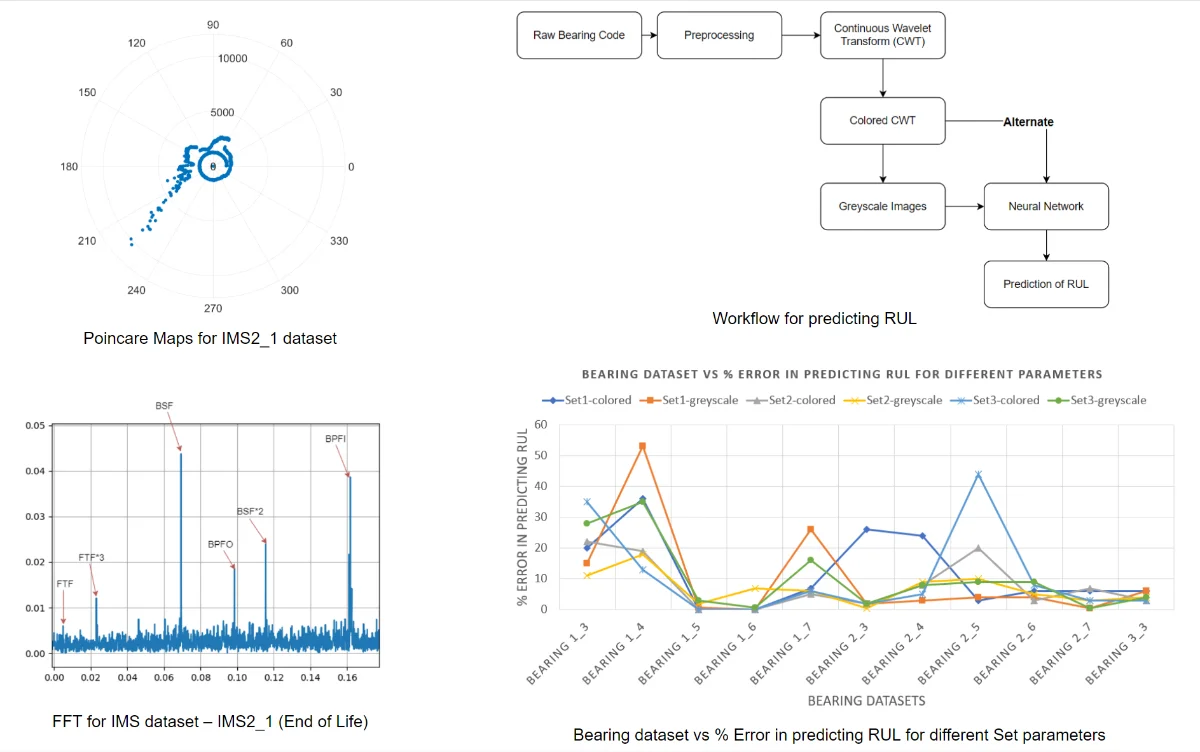
Fault identification and remaining useful life prediction of bearings using Poincare maps, fast Fourier transform and convolutional neural networks
Bearings are integral components of rotating machinery and their failure tends to be a catastrophic failure of the machine. Poincare Maps are used to detect bearing failures using the concept of non-linear dynamics. Each time-domain vibration signature array has its own Poincare Map over a period of time. Fast Fourier Transform (FFT) is a method of analysing the frequency plots of a bearing signature. Convolutional Neural Networks (CNN) process the bearing Continuous Wavelet Transform images and provide the Remaining Useful Life (RUL) of the bearing. The Poincare Maps and FFT plots are used to diagnose the type and location of the fault in the bearing, whereas the CNN helps to provide the fraction of Remaining Useful Life. The study concludes that a combination of Poincare Maps, FFT analysis and Convolutional Neural Networks constitutes a robust and precise method of monitoring bearing conditions.
January 31, 2022
Informatics
Mathematical Models in Engineering
<p>Mathematical results and models specifically applicable to engineering science, technology, and their practical applications across various disciplines</p>
CiteScore
2.6
Licence
CC BY 4.0
Copyright
Retained by the authors
Open access
Free. No embargo
Article Processing Charge (APC)
400 EUR
Best of Theme
Most cited
Research article
June 26, 2022
Recent advancements of signal processing and artificial intelligence in the fault detection of rolling element bearings: a review
By A. Anwarsha, T. Narendiranath Babu
Most cited
Research article
November 4, 2023
A comprehensive review of mechanical fault diagnosis methods based on convolutional neural network
By Junjian Hou, Xikang Lu, Yudong Zhong, Wenbin He, Dengfeng Zhao, Fang Zhou
Most cited
Research article
December 31, 2019
Damage identification of bridge structure based on frequency domain decomposition and strain mode
By Jiaquan Wu, Hongyan Li, Fei Ye, Kun Ma
Most cited
Research article
November 15, 2019
A multi-fault diagnosis method for piston pump in construction machinery based on information fusion and PSO-SVM
By Hongbin Tang, Zichao Wang, You Wu
You might also like
Most downloaded
Research Article
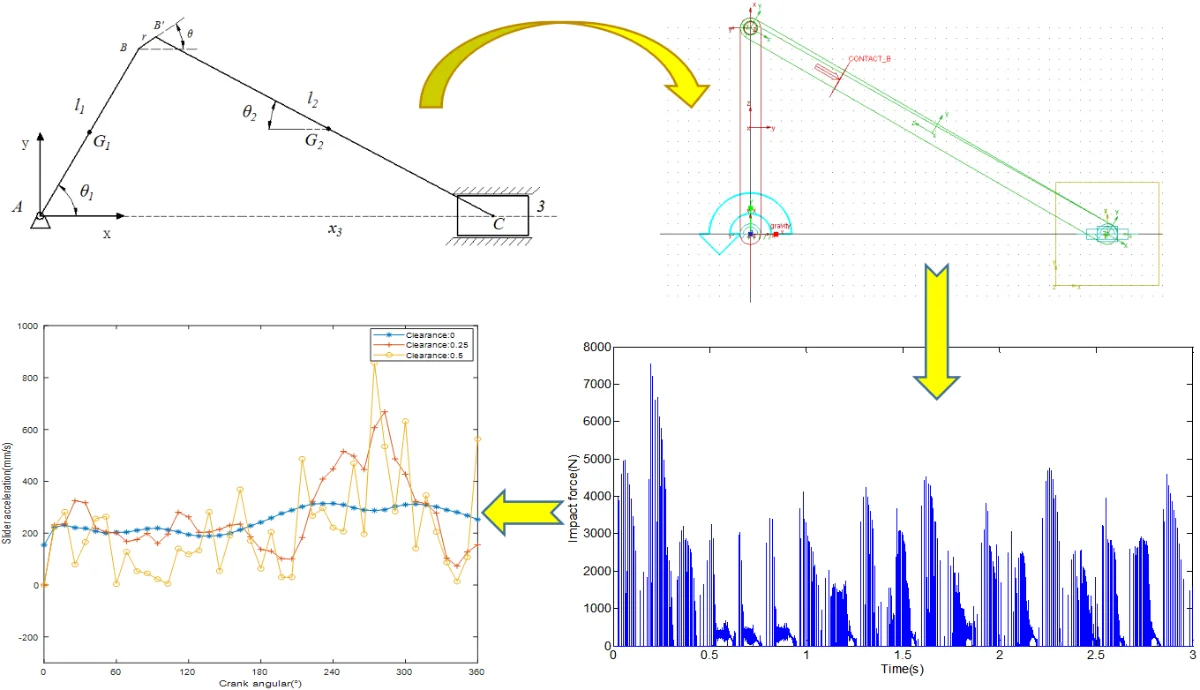
Dynamic analysis of slider-crank mechanism with clearance fault
By Shungen Xiao, Mengmeng Song, Zexiong Zhang
In this paper, the dynamic behavior of the slider-crank mechanism with clearance fault is investigated. The revolute joint with clearance is equivalent to a virtual massless rod, and then the dynamic equation of the crank slider mechanism with clearance is established by the Lagrangian method. In addition, a three-dimensional dynamic model of the crank slider mechanism with clearance is also established by ADAMS. The numerical results show that the clearance affects the displacement and velocity response of the crank-slider mechanism in a weak way, but influences the acceleration response of the mechanism in a significant manner. Due to the existence of the clearance, the revolute joint of the mechanism produces a rub-impact phenomenon, and the larger the clearance, the greater the impact strength. During the rub-impact process, there are three kinds of motion states of separation, collision and contact occur.
November 28, 2019
Applied Mathematics
Most downloaded
Research Article
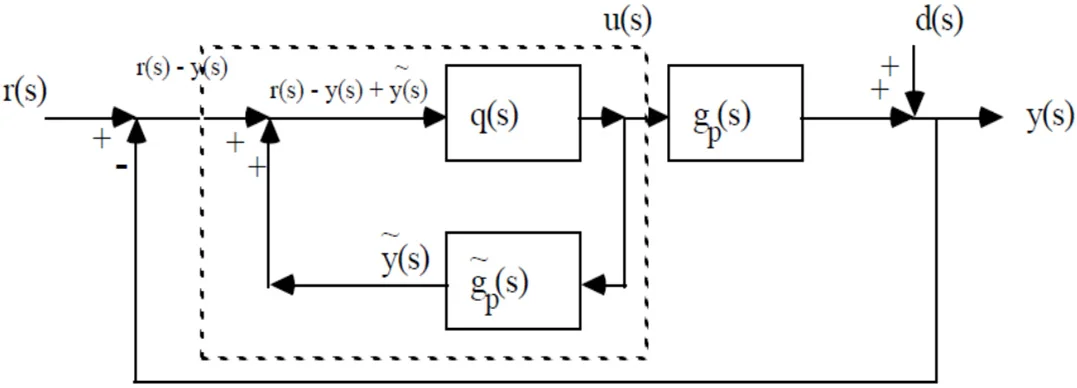
Mathematical modeling of first order process with dead time using various tuning methods for industrial applications
By Sathish Kumar Shanmugam, Yuvaraj Duraisamy, Meenakumari Ramachandran, Senthilkumar Arumugam
The proposed research involves Mathematical modeling for first order process with dead time using various tuning methods for industrial applications. Different tuning methods are proposed. Proposed method selection depends on plant operating conditions and also depending upon the process dynamics. The PID controller is most widely used for industrial process control. Modeling were developed for modified internal control model [4-6] in this proposed research. The proposed work is the modeling and simulation of three different first order processes with dead time. The standard controller tuning method is used to obtain the steady state response of first order with dead time.
March 31, 2019
Informatics
Computational fluid dynamics (CFD) modelling of hybrid photovoltaic thermal system
In this paper an attempt has been made to simulate and evaluate the distribution of temperature and heat flux for the hybrid photovoltaic thermal system with CFD (computational fluid dynamics) module in ANSYS 19.1 software. The simulation was carried to determine the temperature and heat flux across the different layers of HPVT (hybrid photovoltaic thermal) system. The temperature and heat flux were found to gradually decrease from the top glass layer to the bottom tedlar layer. The temperature varied from 36.4 °C (ambient) to 26.8 °C across the layers from top glass layer to bottom tedlar layer. The heat flux of (561.2 W/m2) at the glass layer due to solar insolation was also found to gradually decrease with the increasing thickness. The reduction in temperature and heat flux with increasing thickness is attributed to fluid flowing beneath the system. The water flowing beneath the tedlar layer takes the excess heat out of the photovoltaic layer, thereby increasing the efficiency of the hybrid photovoltaic thermal system.
Research on unbalance response characteristics of gas turbine blade-disk rotor system
Taken a gas turbine rotor system as the research object, this paper has established dynamical model based on transfer matrix method. Natural vibration characteristics are solved with different transfer matrix models, and are compared with that gotten by finite element method. Then unbalanced response is researched. The effects of eccentric factors are discussed on unbalanced vibration. Furthermore, the application is explored in rotor dynamic balancing. The results show there is much minor deviation between natural frequencies of transfer matrix method and finite element method, and vibration modes of two methods coincide quite well. It illustrates the model established in the research is reliable. For input side of blade-disk rotor, unbalanced vibration occurs more easily in lower frequency. While unbalanced vibration of output side is more sensitive at higher frequency. With the increase of eccentric mass, unbalanced vibration of blade-disk rotor is more heavily, and the displacement rotates around a fixed node. The application of opposite unbalanced mass can decrease the amplitude of vibration in lower frequency. Hence, it can be used to achieve the balance of rotor dynamics. This research provides the theoretical basis and technological fundament for gas turbine rotor dynamics design.
